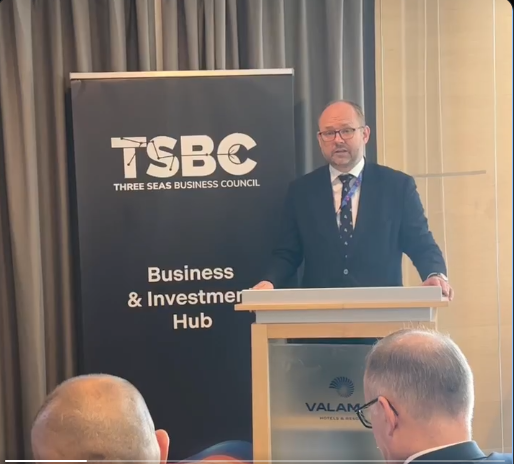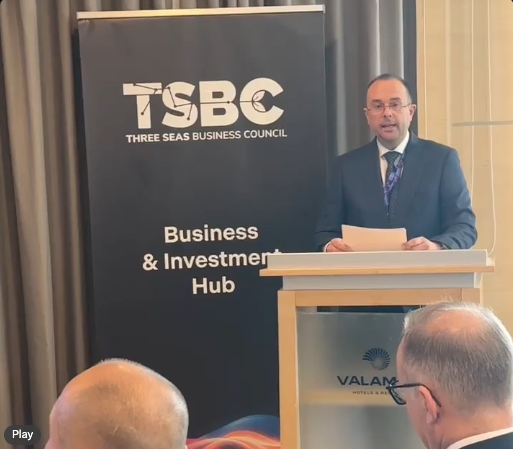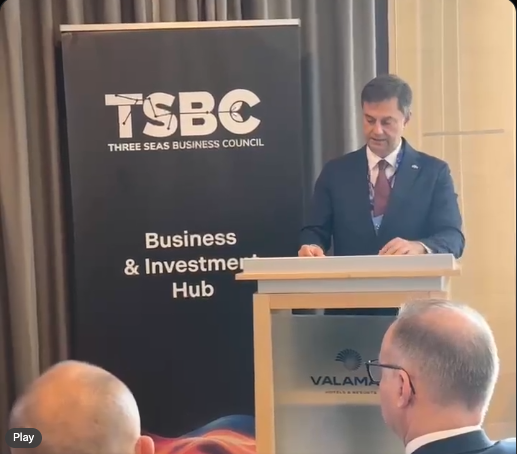
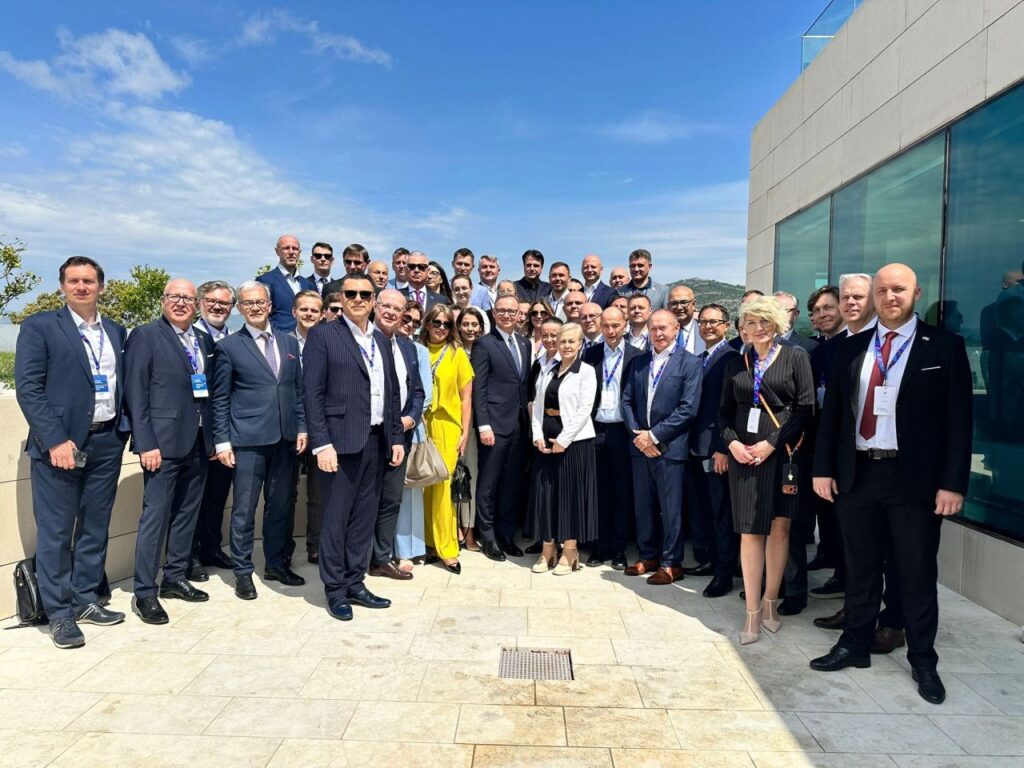
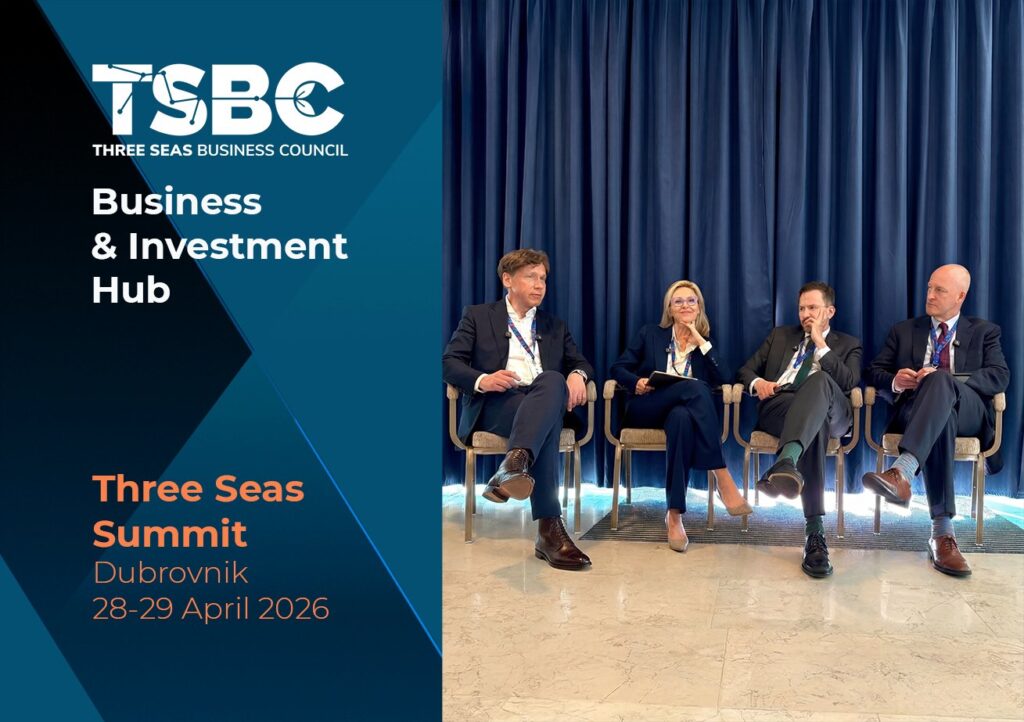
Two days of closed-door TSBC sessions alongside the 3SI Summit and Business Forum carried one consistent message from investors, operators and policymakers: the region’s growth story is clear, compelling and ready to move into its next phase.
———
On 28 and 29 April 2026, the Three Seas Business Council hosted its Exclusive Sessions in Dubrovnik. Five sessions. Three signing ceremonies. A format built for deals, not declarations.
Across two days, partners and participants as varied as Google Cloud, MOL, Synthos Green Energy, the Atlantic Council, the Association of Belarusian Business Abroad, the Japan Bank for International Cooperation and the Selena Group converged on a remarkably consistent diagnosis. The Three Seas region — over 120 million people, combined GDP rivalling the G7, growth at nearly twice the Western European rate for a decade — has cleared the narrative hurdle. What it has not yet built is the Business & Investment Hub that connects that story to the capital waiting to be deployed. This recap focuses on the substance of that diagnosis, and on what it implies for the region’s next moves.
———
DIAGNOSIS 1
The growth story is no longer in question — now is the time to build around it Across every session of the forum, speakers treated the region’s structural attractiveness as a closed question. Google Cloud’s Marcin Krasuski pointed to STEM-engineer density and three decades of GDP outperformance. Digital Poland Association’s Michał Kanownik corrected the persistent misconception that the region lags Western Europe on ICT depth — in fact it leads, on both
specialists per capita and new ICT firms. JBIC’s Nobumitsu Hayashi captured the same shift from the perspective of Tokyo:
“The centre of gravity is moving to the east. Poland has been achieving
very robust growth over many years — we continue to see a lot of
opportunities in digitalisation, just transformation and energy
transformation.”
— Nobumitsu Hayashi, Governor, Japan Bank for International Cooperation
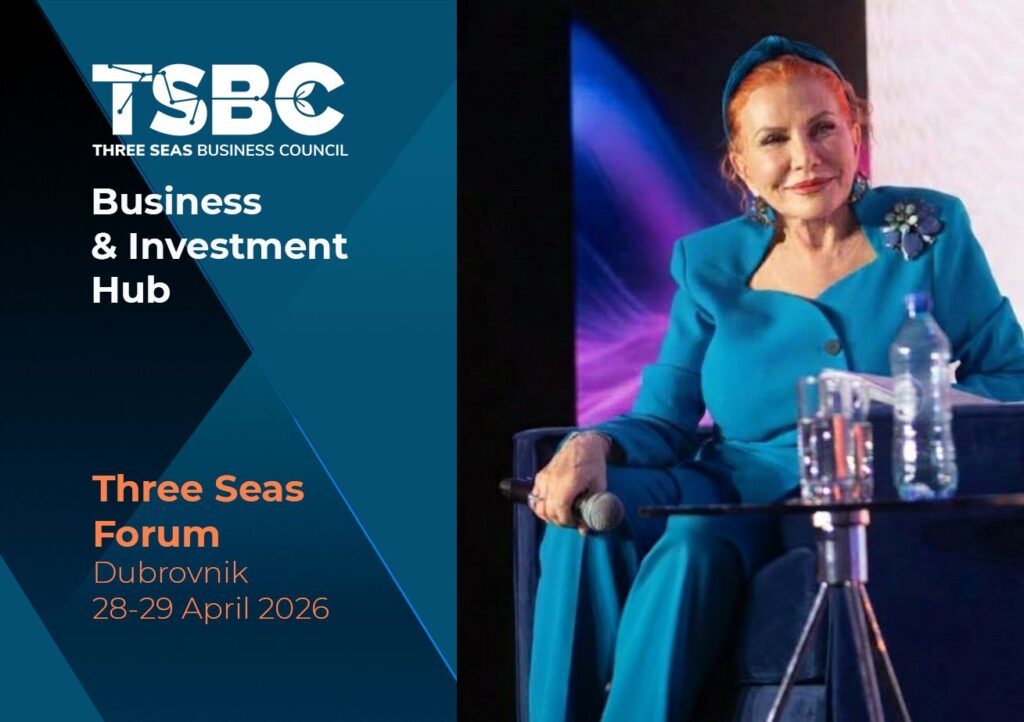
Georgette Mosbacher, Chairperson of the TSBC Strategic Advisory Board, framed the implication directly: structural performance has now produced an inefficiency. Capital allocation lags opportunity. The cause, in her reading, is institutional — the Three Seas Initiative previously had nopermanent secretariat, no central structure, no front door for investors. The TSBC is now emerging as the Three Seas Business & Investment Hub: the standing institution that converts proven opportunity into transactions.
Ian Brzeziński of the Atlantic Council delivered the sharpest formulation of the institutional gap, arguing that the 3SI “operates summit-to-summit” — with two or three months of intensity per year and dry dock in between. His prescription:
- A 24/7 institutional operation, with a permanent convening function and a global marketing arm.
- One visible, 3SI-branded delivered project — a power line, a data line, anything tangible that builds credibility quickly.
———
DIAGNOSIS 2
The binding constraint is risk capital, not entrepreneurship Two speakers from very different angles converged on what may be the forum’s single most
actionable conclusion. Michał Kanownik, from the policy side:
“In this region we don’t have a problem with startups. We have a huge problem with scale-ups.”
— Michał Kanownik, President, Digital Poland Association
Georgette Mosbacher, from the transatlantic capital side, named the consequence:
“Too many companies in the region are built here, but they must go to the United States to scale — because that is where the risk capital is.”
— Georgette Mosbacher, Chairperson of the TSBC Strategic Advisory Board
The implication is structural rather than rhetorical. A region producing world-class founders but exporting them at the moment they become valuable is converting domestic R&D investment into US corporate equity — quietly, repeatedly, and at scale. Closing that gap is not a venture-capita problem alone. It requires a regional fund architecture as Michał Kanownik pointed out, cross border capital access at EU level as Jan Růžička (PPF Group) mentioned, and a working set of cross-border digital projects giving founders reasons to stay (the panel’s collective point).
———
DIAGNOSIS 3
Infrastructure is the binding precondition for everything else The energy and infrastructure sessions converged on a single conclusion that may be uncomfortable but is hard to avoid: full energy independence in 5–10 years is unrealistic, and the right ambition is maximum diversification by source and by direction. Zoltán Áldott, Chairman of the Supervisory Board of MOL, on the underlying logic:
“Our industries, our people, our households are not the most affluent in Europe; they need affordable and reliable energy, which can only be
secured by diversification.”
— Zoltán Áldott, Chairman of the Supervisory Board, MOL
Both Zoltán Áldott and Robert Rudich (Vice President, Synthos Green Energy) identified the grid as the region’s single biggest systemic weakness. Without grid modernisation in the next 10–15 years, electrification cannot scale, and neither renewables nor SMRs nor LNG reach the end consumer
affordably. Robert Rudich on the mindset shift required:
“The grid we have right now is not going to be the grid we have in 2030, in 2035. We’re facing an emergency we really haven’t internalised yet.”
— Robert Rudich, Vice President of the Management Board, Synthos Green Energy
Gianina Pelea, CEO of E-INFRA Group, brought the developer’s answer: EUR 500 million already invested in Romania over five years, EUR 900 million more committed through 2029, with a growing focus on energy storage and on co-locating gas pipelines with HVDC electrical cables — cutting both losses and execution time, and aligning energy supply with where AI data centres will need to sit.
Jan Růžička (PPF Group) translated the same insight into a political diagnosis. Financing is not the bottleneck — bankable projects are. The constraint is harmonising four governments around one project, against asynchronous election cycles, regulatory divergence and competing bilateral interests.
“Less is more. If we could just get four governments together — or in Poland’s case, a real collaboration among Poland, Czechia and Germany at both prime-ministerial and presidential level — it would help us big time.”
— Jan Růžička, Chief External Affairs Officer, PPF Group
———
DIAGNOSIS 4
Transatlantic relationships need ownership, not just trade The geopolitical session yielded one of the forum’s most quoted lines. Russian gas will, at some point, return to European markets at competitive prices. When it does, the contest for the energy mix will be decided not by strategy documents but by household and industrial energy bills.
“Americans don’t own anything here. They trade. They sell us F-35s and Westinghouse. But otherwise, they don’t have so much investment
presence. If you want to mean something here, own something.”
— Jan Růžička, Chief External Affairs Officer, PPF Group
Brzeziński’s long-view response was equally important. The current US administration’s scepticism of Europe and NATO is real, but it is not representative — polling consistently shows 70–90% of the American political establishment, public, and also MAGA base remain committed to NATO and to a values-based foreign policy. His advice to Europe was to take the long bet, not the panicked one
On the Asian side, Governor Hayashi’s message was the practical complement: JBIC has now opened its Warsaw office (its second on continental Europe after Paris), set up the FF Red and White startup vehicle in Poland, and is actively co-financing nuclear projects in Poland and Romania with US partners. The Japanese signal is structural — but, Governor Hayashi noted, it depends on each country in the region actively reaching out to Japanese business.
———
DIAGNOSIS 5
The business community still ahead of policy-makers Krzysztof Domarecki, founder of the Selena Group, closed the TSBC Sessions with what may be its
most pointed governance argument. Twenty years after EU accession, too often in the region we still tend to operate with a “follow Western Europe” mindset that the business community has long since abandoned.
“The social and economic challenges ahead of us in this region are
different from those in Western Europe. Our “elder brothers” have
made so many economic mistakes that we have to say: no more elder
brothers.”
— Krzysztof Domarecki, Founder and main shareholder, Selena Group
The point is not difference for its own sake — Domarecki was careful to reject any essentialist framing. The point is that the region’s actual challenges (governance volatility, infrastructure deficit scale-up gap) require regionally-tailored solutions rather than Western-European templates. And business sees this earlier because business pays the price earlier:
“Business pays the price earlier than politicians — because politicians,
they pay the price every four years.”
— Krzysztof Domarecki, Founder and main shareholder, Selena Group
This is also the reason the Three Seas Business & Investment Hub matters institutionally. It is the channel through which the diagnosis travels from quarterly business reality into political agenda.
———
WHERE THIS LEAVES US
Four priorities for the second decade
Reading across the five sessions, four operational priorities surfaced repeatedly — not as new ideas, but as the items where the gap between consensus and execution is widest:
- A permanent institutional infrastructure for the 3SI — a 24/7 front door for investors and a year-round project pipeline, not a summit-to-summit cycle.
- Grid modernisation and cross-border energy infrastructure as the binding precondition for affordable energy, SMR rollout, AI data centres and industrial competitiveness.
- Following the successful signing of the cooperation agreement between 12 leading space industry companies from six Three Seas countries, there is a clear need to broaden cooperation across the sector, but also in dual-use technologies and the defence economy.
- A regional scale-up capital layer that enables the best companies to grow within the region, instead of being pushed into IP-draining exits just as they become most valuable.
Across all four, one principle holds: the region scales through partnership, not autarky. The Three Seas region needs an ecosystem of cooperation, infrastructure and trusted partnerships to secure its future growth.
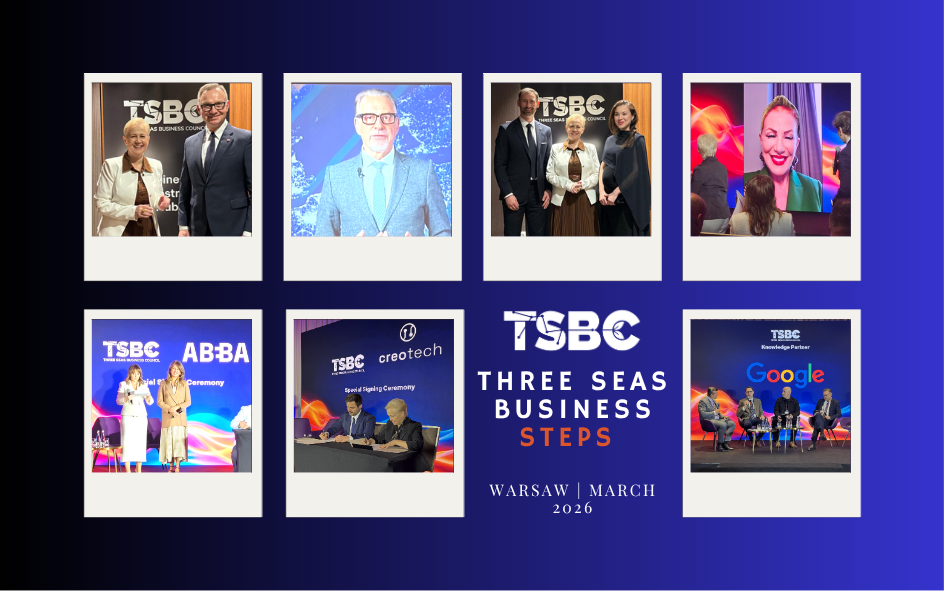
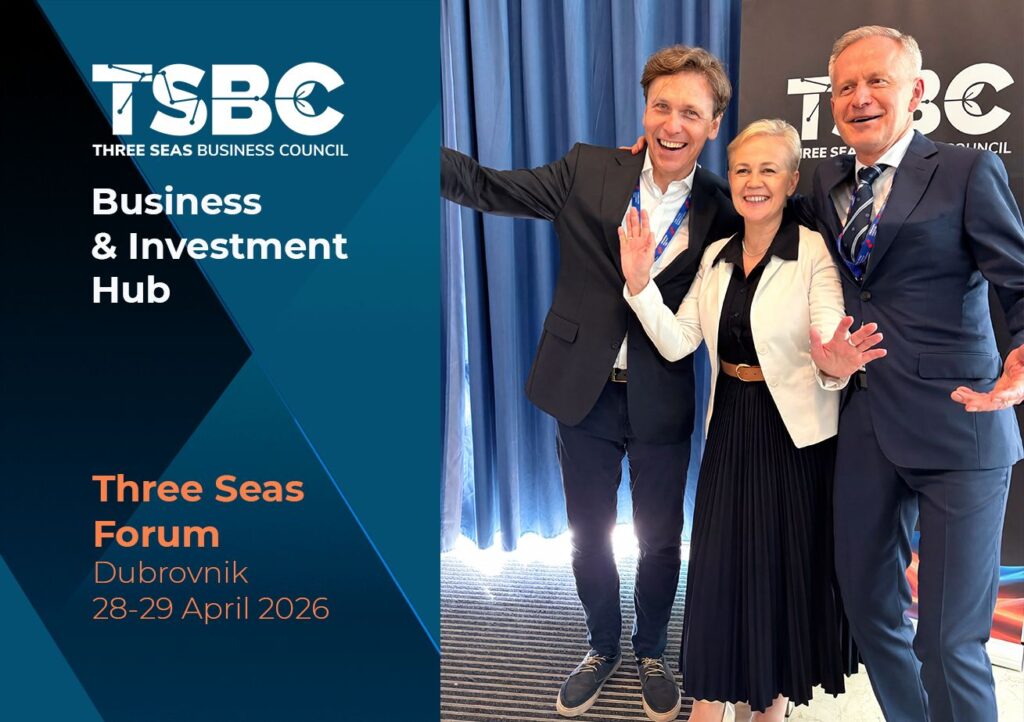
Dubrovnik was the room where that calculation was made visible. The three signing ceremonies — with H2-Hydrogen Cell Croatia Association, Creotech’s twelve-company satellite consortium, and the JP Weber CPPA — made it tangible. The longer work is to build out the Three Seas Business &
Investment Hub Georgette Mosbacher described: the place “where investors can go to vet projects, evaluate risk, access pipeline and deploy capital with confidence.”
The region’s second decade is no longer about telling the story. It is about building the institutional, financial and physical infrastructure that lets the story compound
—
About the Three Seas Business Council
The Three Seas Business Council is the Three Seas Business & Investment Hub: the standing institution that convenes investors, operators and policymakers around bankable cross-border projects in energy, transport and digital infrastructure across the twelve countries between the Baltic, Adriatic and Black Seas.