Connecting Opportunities

Explore the Three Seas 
A concise overview for investors and partners operating across

Countries & Partners

  • Members (13): Austria, Bulgaria, Croatia, Czechia, Estonia, Greece, Hungary, Latvia, Lithuania, Poland, Romania, Slovakia, Slovenia.
  • Associated Participating States: Ukraine and the Republic of Moldova; since April 2025, also Albania and Montenegro.
  • Strategic Partners: United States, Germany, Japan, and the European Commission; Spain and Türkiye joined in 2025.

Why the Region Matters

  • Scale & momentum: a 120M+ consumer and talent market with resilient growth.
  • Connectivity upside: decades of East–West bias create high returns for North–South links.
  • Resilience: energy security, diversified supply chains and digital sovereignty strengthen EU cohesion and transatlantic ties.

The Power of the Economic Potential

From Vision to Assets - 3SI Flagship Projects

Rail Baltica (EE–LV–LT–PL)

Rail Baltica (EE–LV–LT–PL)

A new 1,435 mm standard-gauge line linking the Baltic capitals with Poland; an EU decision on 9 July 2025 set milestones toward full deployment (target ~2030). Impact: Shorter travel times and logistics costs; deeper integration of labour markets and supply chains; stronger military mobility and regional resilience.

Via Carpathia / S19 (LT–PL–SK–HU–RO–BG–GR)
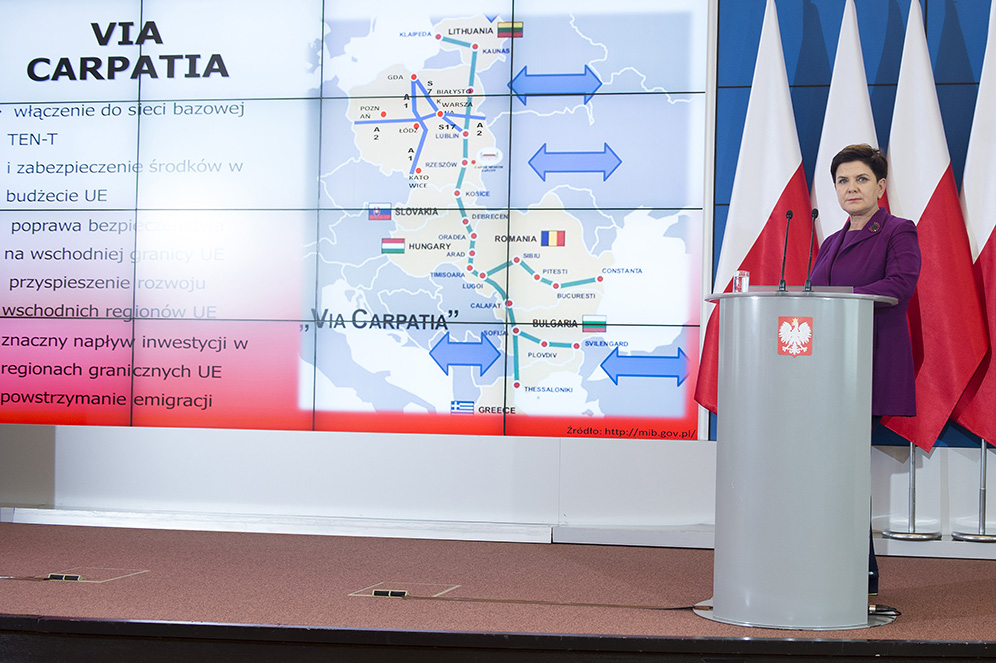
North–South road corridor; in Poland, 712 km (parts delivered, parts under construction), complemented by CEF investments on cross-border sections. Impact: Unlocks the missing N–S axis, speeds up development in eastern regions, improves SME export logistics, reduces journey times.

Baltic Pipe (NO–DK–PL)

Commissioned on 1 October 2022; up to 10 bcm/year from Norway to Poland and 3 bcm/year toward Denmark. Impact: Post-2022 diversification, higher energy security, and improved liquidity in the regional gas market.

IGB – Greece–Bulgaria Interconnector

182.5 km; currently 3 bcm/year with plans to expand to 5 bcm/year.
Impact: Access to LNG/Azeri gas for Bulgaria and the wider Balkans, stronger price competition, reduced dependence on a single supplier.

GIPL – Poland–Lithuania Gas Interconnector

Bidirectional flows; up to 1.9 bcm/year LT→PL and 2.0 bcm/year PL→LT. Impact: Integration of Baltic gas markets with the EU, better utilisation of LNG terminals (Klaipėda/Świnoujście), improved supply stability.

FSRU Krk (Croatia) – LNG Terminal & Expansion

Operational since 2021; planned capacity increase to ~6.1 bcm/year backed by public funding (2025).
Impact: A regional “safety valve” for CEE, flexible LNG imports for HR/HU/SI/AT, reduced price risk.

Synchronization of the Baltic States’ Power Grids with Continental Europe (2025)

On 9 February 2025, Estonia, Latvia and Lithuania synchronised with the Continental Europe synchronous area. Impact: Higher grid stability and security, easier RES integration, full market coupling with the EU’s power and capacity markets.

FSRU Alexandroupolis (Greece)

New floating LNG terminal (commercial start October 2024) with up to ~5.5 bcm/year regas capacity; flows to BG/RO/RS/HU/UA and beyond.
Impact: Additional LNG entry point for Southeast Europe, stronger interconnectors, and greater flexibility of regional gas flows.

Join the Three Seas Business Council Today

Become part of a network that empowers businesses across the region. The Three Seas Business Council facilitates key connections among private enterprises, public institutions, and civil society organizations. Engage in important discussions, enhance your visibility, and drive impactful collaborations. Your contribution will elevate our collective efforts and create opportunities for mutual growth.