
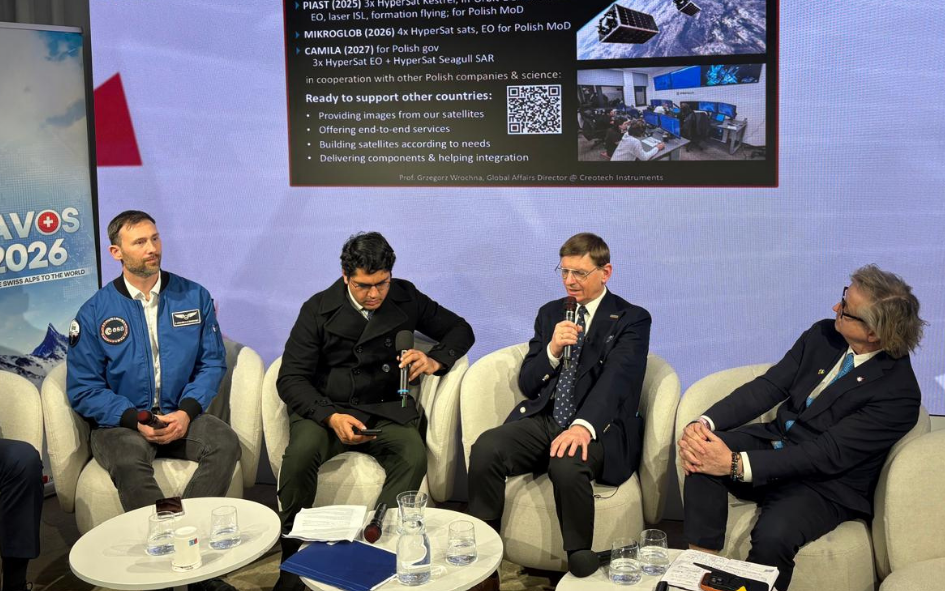
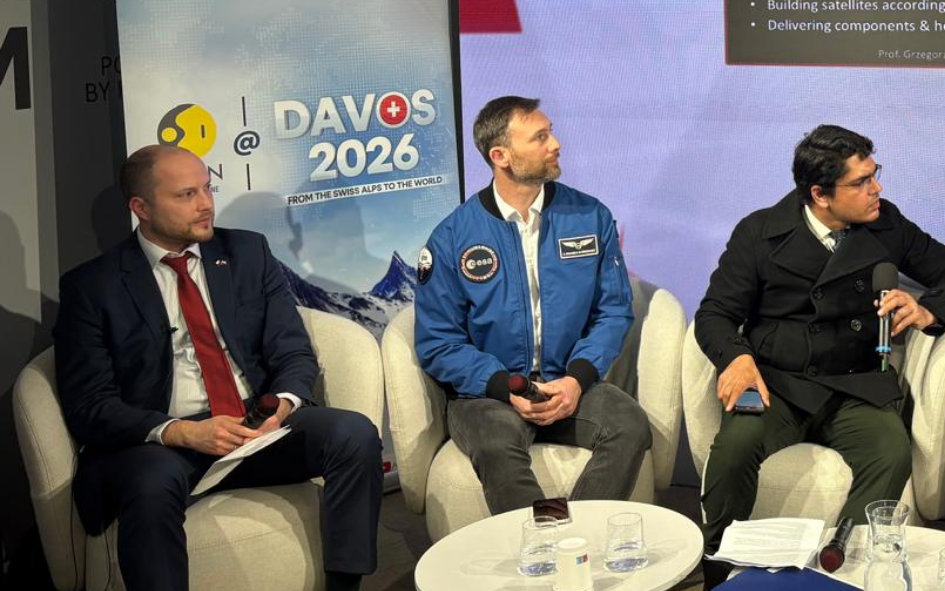
Panel: “Three Seas Initiative in Space: From Earth to Stars — Innovations of the Region”
Leaders Forum, Davos — 21 January 2026
Moderator: Sidhant Sibal
Speakers: Josef Aschbacher, Michal Brichta, Sławosz Uznański-Wiśniewski, Prof. Grzegorz Wrochna
During Davos 2026, the panel dedicated to space technologies clearly demonstrated that the space sector is no longer merely a “future industry.” For the countries of the Three Seas region, it is increasingly becoming a pillar of resilience infrastructure — with tangible applications in security, economic development, and crisis management.
The discussion emphasized the importance of:
- satellite technologies and Earth observation,
- interoperability and cooperation with the European Space Agency (ESA),
- strengthening industrial capabilities and increasing the presence of regional companies in the global supply chain,
- developing downstream applications such as data processing and commercial services,
- and the growing role of satellite data in agriculture, climate monitoring, and disaster response.
Panelists underlined that many development barriers are institutional rather than technological. For cooperation to function effectively at both regional and European levels, policies and governance mechanisms must serve as bridges between industry and decision-makers. At the same time, the region’s potential is clearly expanding — supported by rising investments, strong STEM talent, and a growing readiness to engage in joint programs and cross-border initiatives.
The debate also highlighted that space technologies should not be perceived solely through the lens of exploration or prestige missions. Instead, they represent a critical layer of modern infrastructure — one that enables faster access to data, improves decision-making processes, enhances supply-chain security, and strengthens national and regional autonomy in a rapidly changing geopolitical environment.
The panel further illustrated how collaborative satellite ecosystems — including shared data exchange, coordinated constellations, and potentially shared ground-station infrastructure — could significantly increase efficiency and responsiveness across the Three Seas region. Such models offer not only technical advantages but also strategic ones, reinforcing mutual trust and long-term regional integration.
Ultimately, the Davos discussion made it clear that space technologies may become one of the key competitiveness drivers for the Three Seas region in the coming decade — not only as an industrial sector, but as a comprehensive data and services infrastructure supporting governments, businesses, and public institutions alike. The conclusions point toward a future in which continued regional cooperation in the space domain will require sustained investment and institutional coordination, yet the technological and human-capital foundations already present in the region provide a strong basis for this trajectory.