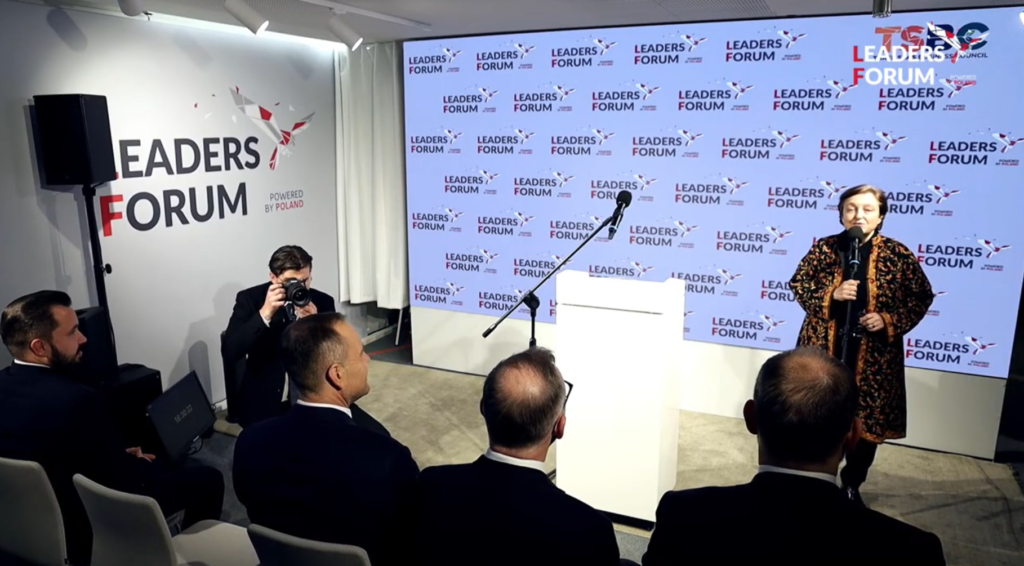

In Davos, during the Leaders Forum powered by Poland accompanying the World Economic Forum, the President of the Republic of Poland delivered a speech on the future of the Three Seas Initiative (3SI). In a strong, geopolitically grounded address, he stressed that with war raging beyond the EU’s eastern border and mounting pressure on the Union’s “front line,” Europe can no longer treat security, competitiveness, and infrastructure cohesion as givens.
At the heart of the message was a clear thesis: the Three Seas region has become one of the key pillars of Europe’s resilience—and a credible bridge connecting the European Union with global partners.
10 Years of 3SI: From an Idea to a Strategic Architecture for Growth
The President recalled that the Three Seas Initiative, launched in 2015, has within a decade evolved from a concept into a strategic framework that is tangibly transforming the region: modernising infrastructure, strengthening security, and accelerating transition.
He also highlighted that the Three Seas is now the fastest-growing part of Europe, and that the region’s dynamism—exceeding its demographic “weight” or traditional economic metrics—contributes to growth across the entire EU.

Transport and Energy: Projects “Stitching” Europe Together Along the North–South Axis
In the section focused on practical outcomes, the President cited investments that, in his narrative, are no longer merely “regional plans,” but elements of a new European map:
Transport
- projects such as Via Carpatia and Via Baltica, connecting the region on the North–South axis and reinforcing market cohesion.
Energy
- Baltic Pipe,
- the Poland–Lithuania gas interconnector,
- the development and utilisation of LNG terminals (including in Poland, Croatia, Lithuania, and Greece),
which—he emphasised—turn past vulnerabilities into assets of resilience.
Digital: The Innovation Potential Is There—Now It’s Time for a crucial Project”
On the digital front, the President noted that the region is among the most innovative in the world, pointing to fintech as a prime example. At the same time, he underlined that a truly distinctive, digital project under the 3SI umbrella is still ahead of us—but, in his view, it is only a matter of time.
In this context, he referenced a significant figure: more than €100 billion spent so far by regional governments on state-of-the-art infrastructure.

Beyond Infrastructure: Defence, Cyber, Space
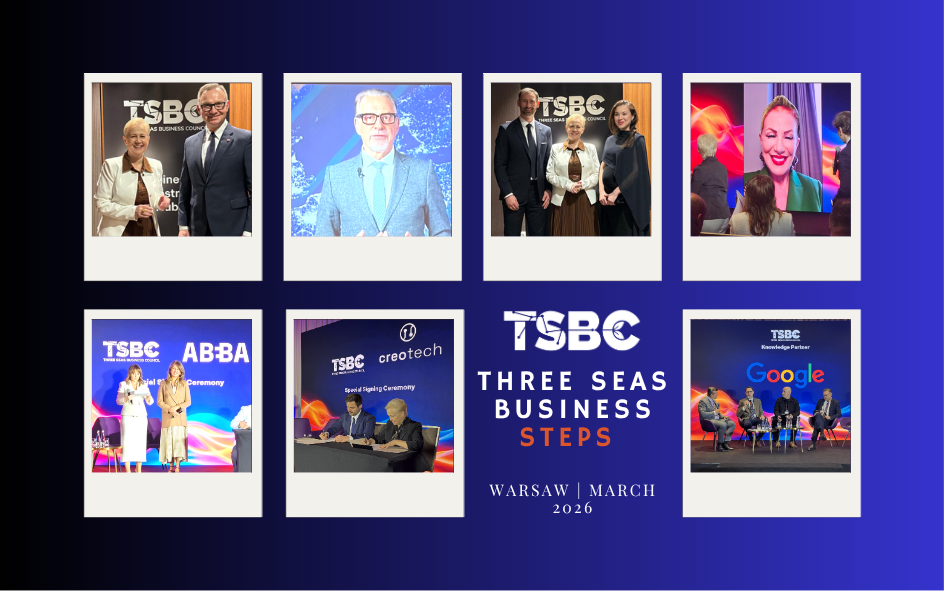
A clear theme in the speech was the widening scope of the Three Seas agenda. The President referred to discussions held during the Three Seas Business Forum in Warsaw (April 2025) organised by Three Seas Business Council, where prospects for expanding cooperation were explored in:
- defence,
- innovation,
- cybersecurity,
- space technologies.
This signals that Three Seas development is meant to address not only infrastructure gaps, but also Europe’s new strategic requirements.
Poland: “3SI it is our common Responsibility”
A key passage addressed Poland’s role. The President stressed that Poland’s leadership in 3SI is not driven by image or prestige, but by the conviction that in the 21st century geography can be an opportunity—if it connects rather than divides.
In the same thread, he referenced Poland’s ambition to strengthen its position in the global economy (including aspirations linked to “entering the G20”)—as a consequence of the country’s growth and regional leadership, relevant for Central and South-Eastern Europe as a whole.
Three Seas Open to the World: The US as a Compass, Asia and the Gulf as Growing Dimensions
The President reminded the audience that the Three Seas has never been an inward-looking project. It was built on the foundation of the transatlantic bond—political, economic, and security—and the US role was described as fundamental in an era of global uncertainty.
At the same time, the speech strongly emphasised further openness:
- Asia—with a reference to Poland’s cooperation with South Korea in defence production and technology transfer,
- Gulf states—as increasingly important investors,
- Japan—as a partner in resilient supply chains, with emphasis on Tokyo’s decision to become a strategic partner of 3SI.

3SI at Scale: 140 Priority Projects and a Market of 120 Million People
The speech also underlined hard parameters of scale:
- 140 key projects identified under the regional investment framework,
- over 120 million people—meaning a market offering predictability, growth momentum, and attractiveness for capital.
“We Are Building Not Only Roads, but Confidence”
In the closing segment, the President shifted the focus from infrastructure metrics to the social and strategic dimension. Success—he argued—should not be measured solely in kilometres of highways or gigawatts of capacity, but in the resilience and prosperity delivered to citizens.
He also captured the essence in a broader framing: the Three Seas is no longer the EU’s “eastern periphery,” but a new frontier of creativity, capability, and prosperity—provided we sustain the pace of cooperation and strengthen connections with the Atlantic and Asia.
What Does This Mean for TSBC?
The speech is an important signal for business and investors: the Three Seas is seen not only as an infrastructure plan, but as a platform for building Europe’s resilience and competitiveness—based on partnerships, capital, technologies, and joint projects.
For the Three Seas Business Council, this strengthens the mandate to act: connecting companies, projects, and capital, enabling cross-border cooperation, and translating political ambition into real economic delivery.